Prices in this guide are in Australian dollars (A$). Every watch shows its current price in your currency on its product page.
The part of the watch you actually wear
People choose a watch by the dial. Colour, indices, whether it has a date window. Then the watch arrives and the part they spend all day with is the bracelet.
The bracelet decides the weight. It decides how the watch sits when your arm hangs down, whether the case stays centred or slides under your wrist, and how the whole thing reads across a room. Change nothing but the bracelet and you get a different watch. A sports watch becomes a dress watch. A quiet watch starts throwing light.
Three designs cover almost everything people want: the Oyster, the Jubilee and the President. They are not interchangeable. Here is what each one does on the wrist.
Oyster: three links, flat, the default
Three links across. One wide centre link with a narrower link either side. Flat top surfaces, typically brushed outers with a polished centre.
The Oyster is the default and it earned that. Flat tops mean it reads as one continuous band of steel rather than a chain of small parts, so it disappears under a cuff and does not compete with the dial. The links are large, which means fewer of them, which means less articulation and a stiffer feel.
That stiffness is the trade. An Oyster holds its shape. It does not so much wrap your wrist as sit around it, and on a wrist with a pronounced taper it can leave a small gap at the six o'clock side. Some people never notice. Others notice immediately.
What it does to a watch: it makes it sportier and more serious. An Oyster on a Datejust build is the version you wear to work every day and stop thinking about, which is the highest compliment you can pay a watch.
Ours is 316L stainless steel, 20mm lug width, A$59.95. Oyster Bracelet.
Jubilee: five links, dressier, more light
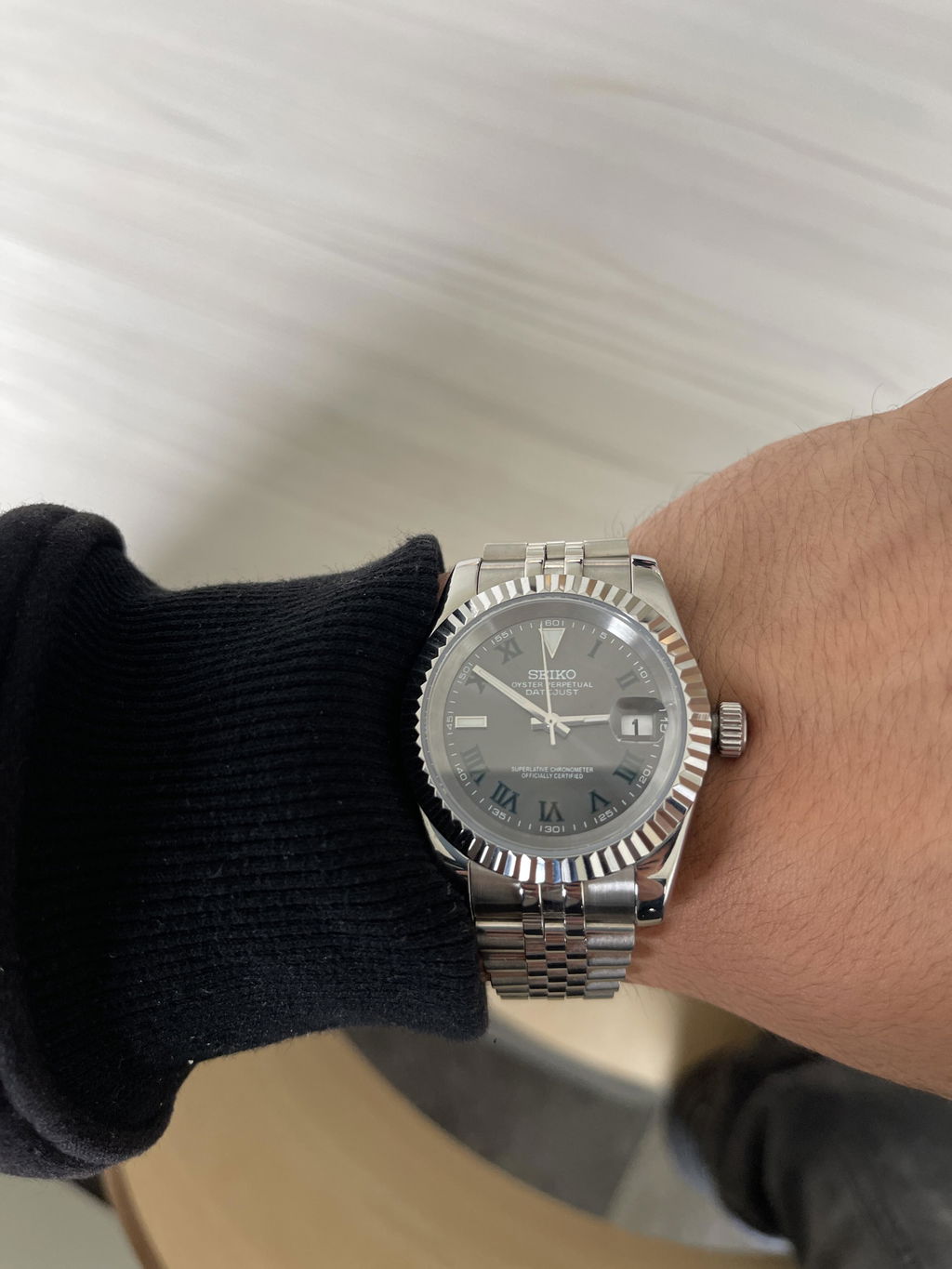
Five links across instead of three. Three small polished centre links running down the middle, flanked by two larger outer links. Twice the parts, half the size, and the difference is immediate.
More links means more articulation. A Jubilee bends in smaller increments, so it follows the curve of a wrist rather than approximating it. On a small or flat wrist that is the difference between a bracelet that drapes and one that hovers.
The other difference is optical. Those polished centre rows behave like a chain of small mirrors. Move your arm and the Jubilee flickers, catching light along its length where the flat Oyster catches it in one broad sweep. It is busier, and it is why a Jubilee reads dressier without reading formal.
One honest note. The Jubilee style appears on some builds, but we do not sell a Jubilee bracelet on its own. If you want that look, choose it on the build rather than planning to add it later. Our loose accessories are the Oyster, the President and the Oyster Flex strap.
President: three links, semi-circular, the dressiest
Three links again, but the geometry is different. Each link is semi-circular in profile. No flat top surfaces anywhere. The bracelet is a run of rounded steel, usually with more polishing than either of the others.
That profile does two things. It sits taller than an Oyster of the same thickness, so the watch feels more substantial without weighing more. And because there are no flats, light rolls across it continuously instead of striking one plane at a time. The effect is closer to jewellery than to hardware, which is the point.
The President is the dressiest of the three by a wide margin. On a plain dial in a modest case it reads as a proper dress watch. The honest warning: polished steel shows fine scratches sooner than brushed steel does. Not damage. Just the patina of a watch being worn, more visible here than on an Oyster.
20mm lug width, A$59.95. President Bracelet.
How each one drapes
Drape is the word for how a bracelet falls around the wrist rather than sitting on top of it. It is the thing most people fail to consider before buying.
Ranked from most to least flexible: Jubilee, then President, then Oyster. More links, smaller links, better drape.
Weight distribution follows from that. A flexible bracelet spreads the mass of the case around your wrist, so the watch feels lighter than it is and stays centred. A rigid one concentrates it under the case, and if the fit is loose the head migrates.
Wrist size, honestly
Measure your wrist with a tape. Do not guess.
Under about 16 cm: a Jubilee-style bracelet or the silicone strap will treat you better than a rigid Oyster. Smaller links follow a tighter curve, and a stiff bracelet on a small wrist reads as oversized even when the case is not.
Between 16 and 18 cm: anything works. This is the range every bracelet was designed around, so the choice becomes purely about character.
Over about 18 cm: the Oyster comes into its own. Broad flat links look proportionate where a Jubilee can start to look finely detailed against a larger case. The President stays elegant at any size, and stays dressy at any size too.
Bracelets are sized by removing links. The fit you want is snug enough that the case stays on top of your wrist, loose enough to slide a fingertip under the clasp. Wrists swell in heat. Size to a warm afternoon, not a cold morning.
The silicone option
Not every day is a steel day. The Oyster Flex silicone strap is A$49.95, 20mm, and it changes the watch more aggressively than any metal option. Steel to silicone takes a dress watch and makes it a weekend watch in about ninety seconds.
Lighter, indifferent to sweat, sensible for summer. It will never look dressy. Fair trade at the price.
Same watch, three characters
Take one Datejust build. Same case, same dial, same hands.
On an Oyster it is a daily watch. Understated, brushed, reads as considered rather than decorative.
On a Jubilee it is dressier and more animated. The polished centre rows lift it. It looks like a watch someone chose rather than a watch someone owns.
On a President it is a dress watch. Rounded, polished, closer to jewellery. At home with a jacket and slightly conspicuous without one.
Three watches, one head. This is the argument for buying a second bracelet before you buy a second watch, and at A$59.95 it is not a difficult argument to make.
What you are getting either way
Every build starts from 316L stainless steel with a sapphire crystal, which resists scratching in a way mineral glass does not. Water resistance is splash-resistant. That covers rain, hand washing and getting caught out. It is not a swimming watch and we are not going to imply it is.
Every watch is built to order, carries a 1 year warranty, honoured worldwide, and ships worldwide free. Datejust builds start from A$299.
Which one to pick
Want one bracelet and no thinking? Take the Oyster. It is right most of the time.
Smaller wrist, or you want the watch to catch light? Look for a Jubilee-style build.
Worn with a jacket more often than not? Take the President and accept the polishing.
And if you already own the watch, the cheapest interesting thing you can do to it is change what it is attached to.
Made to be looked at twice.
Accessories · Oyster Bracelet · President Bracelet · Oyster Flex Strap · Datejust · Datejust homages explained · Royal Oak mods compared · Sapphire vs mineral crystal · Water resistance, honestly
Sources
Primary references for the technical and regulatory claims above.
- Britannica, Corundum - what sapphire crystal is made of.
- ACCC, Consumer rights and guarantees - the statutory guarantees that apply on top of any warranty.