Owner's Manual
Everything you need to set, wear and look after your watch. If you read one section, read the first one.
Your watch will arrive stopped, and that is normal
A mechanical watch has no battery. It runs on a spring, and that spring is wound by the movement of your wrist. Your watch has been sitting in a box since the day it was built, so the spring is flat and the hands are still. Nothing is wrong with it. Wind it.
To wind it:
- Make sure the crown, the small knob on the side of the case, is pushed all the way in.
- Turn the crown clockwise, away from you, at least 55 full turns.
- The second hand will start to sweep. Give the watch a gentle shake if it does not start straight away.
Once it is running, wearing it through a normal day keeps it wound. Leave it off your wrist for more than about 41 hours and it will stop again, and you wind it the same way.
If your watch is a chronograph, the stopwatch style with small dials and two buttons beside the crown, it runs on a battery instead and will already be ticking when you open the box.
Which movement is in your watch?
Your movement is named on your product page and on your order confirmation. If you would rather not go looking, tell it from the dial:
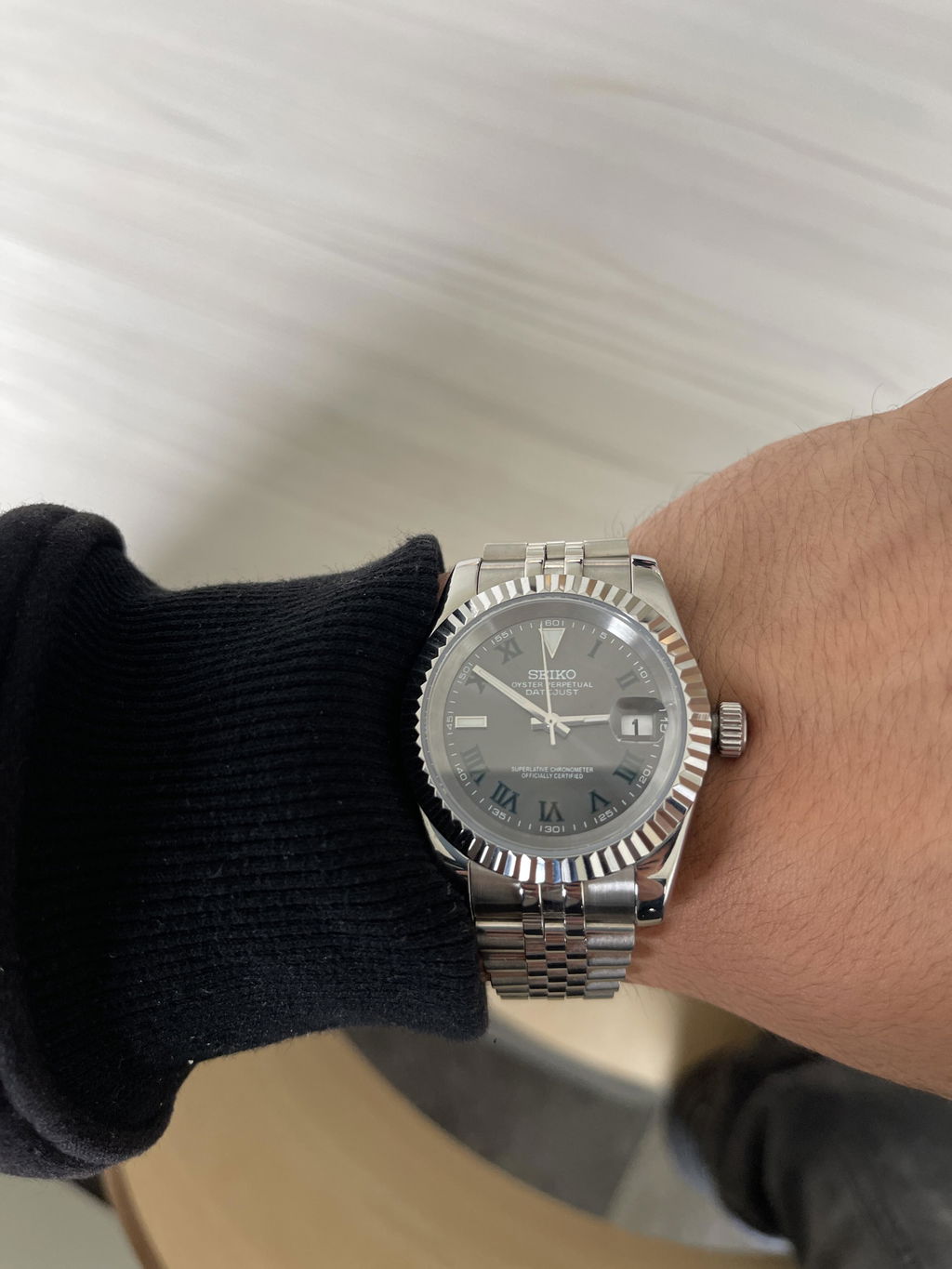
- Smooth sweeping second hand, one date window: NH35
- An extra slim hand with a coloured or arrow tip, plus 24 hour markings: NH34 GMT
- A day window and a date window: Miyota 8285
- A cut-out on the dial showing the balance wheel swinging: NH38
- A dial that is mostly open, gears visible across the face: NH70
- Small dials and two push buttons beside the crown: VK63
Not sure, or you own an older Rosevari with a movement that is not on this list? Send us a photo of the dial and we will send you the right instructions.
The crown: read this before you set anything
Every Rosevari watch has a screw-down crown, so it is locked shut and you have to free it first. Turn the crown anticlockwise, towards you, until it springs out on its own. Now it will pull out to the settings positions.
There are three positions, and every instruction below refers to them:
- Pushed all the way in. This is where you wind it.
- One click out. Date, day, and the 24 hour hand on a GMT.
- Two clicks out. Time. The second hand stops dead here, so you can set it against a phone clock.
When you have finished, push the crown all the way in and turn it clockwise until it is firm. Do not force it, it should thread smoothly. A crown left unscrewed is an open door into the case. Pull and push the crown straight and gently, with no sideways pressure.
One rule applies to every watch here: never set the date between 9pm and 4am. Inside that window the movement is already part way through its own date change, and forcing it can damage the mechanism. If it is late in the evening, wind the hands round to a morning time first, set the date, then set the time properly.
Setting an NH35: time and date
Time. Pull the crown out two clicks. Turn it to move the hands. Run them past 12 and watch whether the date flips, that tells you you have crossed midnight rather than midday. Push the crown back in.
Date. Pull the crown out one click. Turn it to the left. Push the crown back in.
Setting it exactly. At two clicks the second hand stops dead. Pull it out on the minute, set the time against a phone clock, then push it in exactly on the minute.
Setting an NH34 GMT: time, date and a second time zone
This is a true GMT. The 24 hour hand is set independently, which is what makes it useful for travel and slightly different to set.
Time. Two clicks out, turn to set the hour and minute hands, push back in.
Date. One click out, turn it to the left.
24 hour hand. One click out, turn it to the right.
How to use it. Set the main hands to the time where you are. Set the 24 hour hand to the time somewhere else and read it against the 24 hour markings on the bezel or inner ring. If your bezel rotates, turn the bezel to track a third zone without touching the crown at all.
Setting a Miyota 8285: time, day and date
Time. Two clicks out, turn to set the hands, push back in.
Date. One click out, turn it to the left.
Day. One click out, turn it to the right.
If the day rolls over to the next day while you are setting the time, you have passed midnight rather than midday. Keep going round until it reads the right half of the day.
Setting an NH38 or NH70: open heart and skeleton
These have no date, so there is only one crown position to worry about. Pull the crown out to the first click, turn it to set the hands, push it back in. There is no second click on these.
The balance wheel swinging back and forth is the movement working. That flicker is the whole point of the watch, and it means it is running.
Using a VK63 chronograph
Worth knowing what this is. The timekeeping is quartz, run by a battery. The stopwatch is a real mechanical module. That is why the stopwatch hand sweeps and snaps back like a mechanical chronograph while the watch keeps quartz accuracy. It is not an automatic. It does not need winding and it will not stop when you take it off.
Time. Two clicks out, turn to set the hands, push back in.
Date. One click out, turn clockwise, push back in.
The stopwatch. The top button starts it, and stops it. The bottom button resets everything to zero. You can start and stop as often as you like before resetting, and the times add up. It measures up to 60 minutes.
If the stopwatch hands are not sitting at zero, which can happen after a knock or a battery change:
- Pull the crown out two clicks.
- Hold the bottom button for two seconds, then let go.
- Push the crown back in.
- Leave it alone for ten seconds. The small second hand steps in two second jumps while it finds zero. Do not touch the crown during those ten seconds.
Battery. An SR936SW cell, which lasts about three years. Any watchmaker or jeweller can change it in a few minutes. You do not need to send the watch back to us.
Water: what your watch is actually rated for
We would rather be blunt here than have you find out the hard way.
Every Rosevari watch is splash-resistant as standard. Rain, hand-washing, getting caught in the weather and everyday wear are all fine. Swimming, showering, bathing, snorkelling and diving are not.
The dive look on our Submariner-style and SeikDweller-style watches is a design tribute, not a dive rating. Ignore any depth number printed on a dial in this category.
Unless you chose a water upgrade when you ordered. Two were available at order time:
- Swim-Ready, 5 ATM. Swimming is fine. Showering and diving are still not.
- Dive-Ready, 10 ATM, Submariner only. Swimming and occasional showering. Not diving.
Not sure which you have? Check your order confirmation email, or reply to it and we will check for you. If it does not say Swim-Ready or Dive-Ready, your watch is splash-resistant. These upgrades are chosen during the build and cannot be added afterwards.
Whatever your rating, screw the crown down before the watch goes anywhere near water. An unscrewed crown floods the case, and no rating protects a watch that is open. Water damage is not covered by the warranty. Seals also age, so water resistance describes a watch on the day it was built, not a promise that holds forever.
Sizing your bracelet
Most of our bracelets are adjusted by removing links. Work on a soft cloth so nothing gets scratched, and keep every link and pin you take out. You will want them if your wrist changes or you ever sell the watch.
Screw-pin bracelets: Oyster, Jubilee, President.
- Lay the bracelet on a link holder block.
- Turn the screw anticlockwise with a small flat screwdriver until it comes out.
- Take out as many links as you need, removing the same number from each side of the clasp so the clasp stays centred on your wrist.
- Put the screw back and turn it clockwise until firm.
Push-pin bracelets, including integrated Royal Oak and Nautilus styles.
- Find the small arrows stamped inside the bracelet. The pins only come out in the direction of the arrow.
- Lay it on the holder block with the arrows pointing down.
- Tap the pin out with a pin punch and a light hammer.
- Remove or add links, then push the pin back in from the opposite side until it sits flush.
Fine tuning. Most clasps have several small holes for micro-adjustment. Move the clasp pin one hole along before you commit to removing a whole link. A wrist is bigger at the end of a hot day than at the start of a cold one, so a little play is comfort, not a bad fit.
Rubber straps. Some are shortened by cutting. Measure twice. Mark both sides evenly, cut a small amount at a time, test the fit after each cut, and smooth the edge with a nail file. A cut strap cannot be made longer again.
Or let us do it. Tell us your wrist size before your watch ships and we will size the bracelet for you before it leaves. It costs nothing, and it is easier than doing it yourself at the kitchen table.
Living with a mechanical watch
How accurate is accurate? A mechanical watch is a spring and a set of gears, not a quartz crystal. It will not keep time like your phone, and it is not supposed to. Seiko publishes the tolerance for the NH35 as -20 to +40 seconds a day at room temperature. That sounds like a lot until you realise almost every mechanical watch ever made behaves this way, including ones that cost twenty times more.
Accuracy also shifts with how you wear it and which way up it rests overnight. If yours runs fast, try leaving it dial-up. If it runs slow, try leaving it crown-up. A few nights of experimenting often gets a watch closer than any adjustment would. If your watch is out by minutes a day rather than seconds, that is not normal. Talk to us.
Power reserve. More than 41 hours from fully wound. Wear it daily and it looks after itself. Take it off on Friday evening and it will have stopped by Sunday morning. A watch winder keeps an automatic running while it sits off your wrist, which saves you resetting the time and date.
Magnets. The commonest cause of a mechanical watch suddenly running very fast. Magnetic phone mounts, laptop lids, speakers, handbag clasps and fridge doors are all worth keeping a distance from. A magnetised watch can be demagnetised by any watchmaker in a couple of minutes.
Knocks, heat and cleaning. Take it off for the gym, for anything with impact, and for a sauna. Large temperature swings affect timekeeping. Clean it with a soft dry cloth, and a steel bracelet with a soft toothbrush and a drop of soapy water, keeping the watch head out of it, then dry it properly.
Servicing. A mechanical movement wants a service every five to seven years, and any watchmaker can do it. The movements in our watches are standard, widely used and serviced everywhere, which is one of the reasons we use them.
Something is not right
- Not running out of the box. The spring is flat, which is normal. Wind it 55 turns.
- Stops overnight, runs when worn. Not enough wear to keep it wound. Wind it by hand in the morning.
- Suddenly gaining minutes a day. Magnetised. Any watchmaker can demagnetise it.
- Date flips at noon, not midnight. The hands were set 12 hours out. Move them 12 hours forward.
- Date did not change overnight. It was set inside the 9pm to 4am window. Set it again during the day.
- Stopwatch hands not at zero. The chronograph needs re-zeroing, see the VK63 section.
- Chronograph has stopped completely. Battery. Any jeweller can replace it.
- Crown will not turn. It is screwed down. Turn it anticlockwise until it pops out.
- Bezel turns one way only. That is how a dive bezel is built. Nothing to fix.
- Moisture under the crystal. Water has entered the case. Stop wearing it and contact us today.
Anything not on this list, or anything that looks like damage: contact us. Send a short video or a few photos of what is happening. We do not make you prove anything first, and we do not charge you postage either way.
Your watch carries a 1 year warranty. Normal wear, scratches and water damage are not covered.
Manufacturer manuals
The original documents from the companies that make the movements, if you want the full technical detail. Each one is the manual for the movement inside that family of watches.
- NH35 DATEJUST / SUBMARINER / SANTOS, ETC. USER MANUAL
- NH34 GMT USER MANUAL
- VK63 DAYTONA / SPEEDMASTER, ETC. USER MANUAL
- NH38 OPEN HEART NAUTILUS / ROYAL OAK USER MANUAL
- NH70 ROYAL OAK SKELETON USER MANUAL
- MIYOTA 8285 DAY-DATE USER MANUAL
Still stuck? Email us and a real person answers, usually within 24 hours, weekends included. Tell us your order number and what the watch is doing.